T-02 Province I · The Founding Coast The Old Charts 5 min 2 of 21
History, Foundations & Probabilistic Formulation
Where "world model" ideas came from before the name existed, and the probability math that makes them precise.
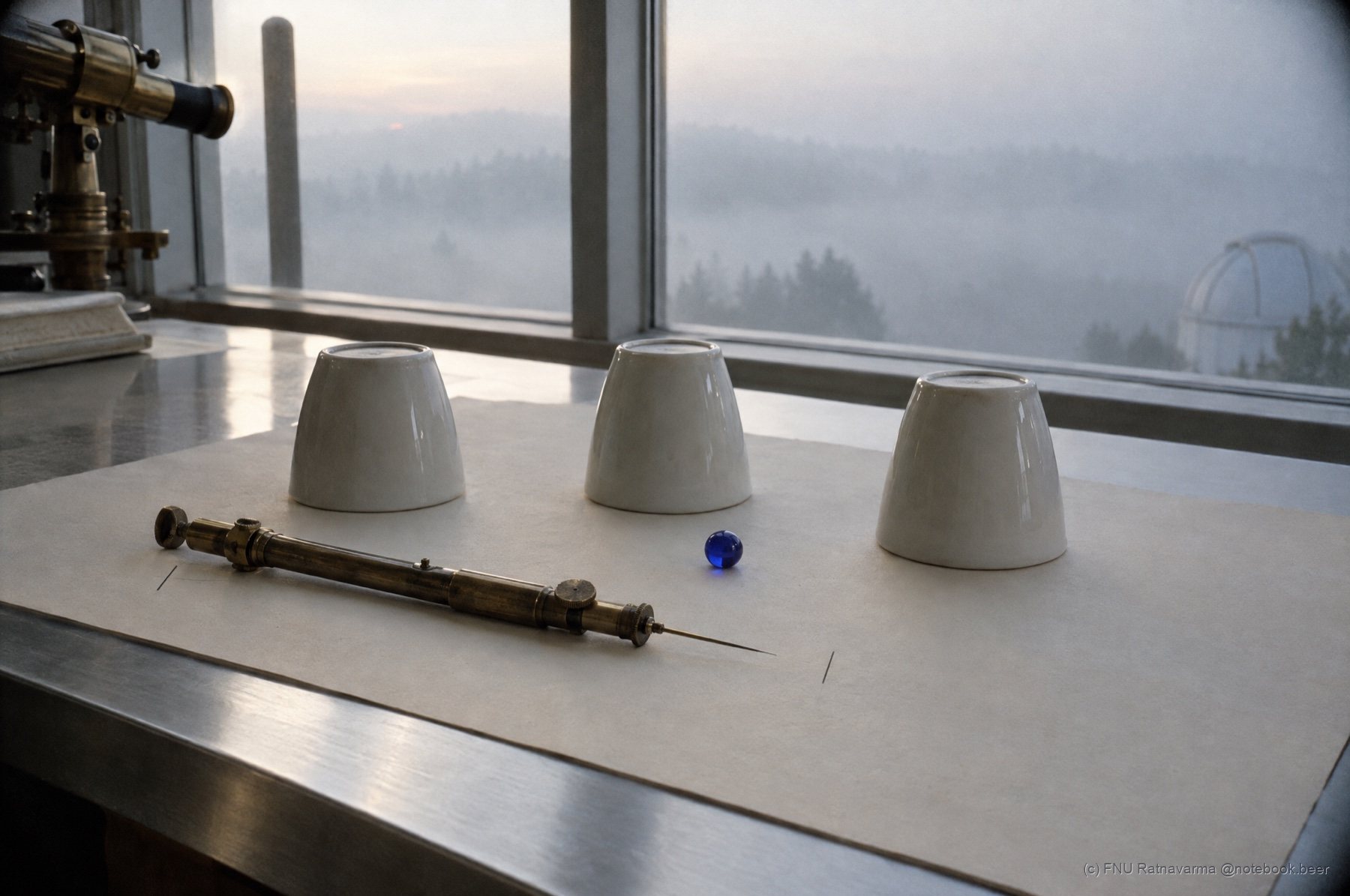
In one sentence The world is only ever half-visible, so a good model keeps a running best guess, a belief, about the rest.

Picture three cups upside down on the kitchen table. Dad hides a coin under one of them. Then he slides the cups around, fast.
You cannot see the coin. You can only see the cups. So you keep a guess in your head.
Maybe you feel sure it is under the left cup. Maybe you think it could be left or middle, but never right. That spread-out guess has a name. Scientists call it a belief.
A belief is your best idea of what is hidden, plus how sure you are. You almost never see the whole world at once. You see a slice and guess the rest.
Now Dad slides the left cup and you hear a tiny clink. That is a clue. Your belief moves. Now you feel much surer about the left cup.
Every clue nudges the guess. Keeping the guess fresh, moment to moment, is most of what understanding means.
This idea is very old. Weather forecasters guess about clouds they cannot fully see. Chess players picture boards that do not exist yet. In 1960 an engineer named Rudolf Kalman wrote it down in numbers.
What changed lately is who builds the guessing machine. Computers now learn it from experience. Nobody has to write the rules for them first.
My work uses this for electricity. A meter on a house sends a reading now and then. The computer never sees every wire. It keeps a belief about what happens between the readings.
Try this with a grown-up. Play the three-cup game with a coin. Before you lift a cup, spread ten dry beans across the cups. More beans means more sure.
Then lift the cup with the most beans. See how your beans did. Play five rounds. Do your beans get smarter?
The field inherits its math from control theory and Bayesian filtering. The standard frame is the partially observable Markov decision process, or POMDP. The true state is hidden. The agent sees only an observation at each step.
A belief state summarizes everything seen so far. It is a distribution over the current state, given all past observations and actions. Kaelbling, Littman and Cassandra (1998) showed how to plan over beliefs. Their POMDP treatment is still the reference.
Every belief update has two moves. Predict pushes the belief forward with a model of the dynamics. Correct pulls it toward the new observation, weighted by how much each side is trusted.
Kalman (1960) solved this exactly for linear systems with Gaussian noise. Particle filters later approximated it for messier systems, using many weighted samples. Both needed a person to write down the dynamics and the noise.
Modern world models replace those assumptions with a learned latent variable and a neural transition. The belief update itself becomes a differentiable, trainable operation. PlaNet (Hafner et al., 2019) is the clean example. Its recurrent state-space model has a deterministic path and a stochastic path.
In PlaNet the prior is the predict step and the posterior is the correct step. The agent plans in latent space from pixels alone. Casting the problem as inference over trajectory distributions is what lets one scaffold stretch far. It reaches a robot arm, a video generator and a language model's internal state.
Here is the feeder version, from a lab I use for teaching. A Kalman filter tracks a feeder's true load from noisy readings. The raw sensor had an RMS error of 1.16 MW. Predict, then correct, brought it to 0.42 MW.
Then the lab switches the sensor off after hour 48. Mean error rose from 0.31 MW to 0.63 MW. That growth is the model's own error, with nothing left to correct it. Meter data with gaps and late reads behaves exactly like this.
Three failure modes matter in practice. An overconfident filter sets process noise near zero and stops listening to the meter. A filter that diverges reports small uncertainty while its error grows. A deterministic model facing a forked future predicts the average, which may never happen.
I would recommend to measure calibration first. About 90 percent of outcomes should land inside a 90 percent band.
Check the innovations too. These are the gaps between prediction and reading. They should look like the assumed noise.
Then test the gaps on purpose. Hide readings for a day and watch how fast the error grows.

World models are older than the current wave. They are the learned form of decision machinery with decades of service. Aerospace, finance and operations research have relied on it for decades.
That lineage matters commercially. The safety tooling built for those fields is directly reusable. Confidence intervals on a belief, calibration checks and filter divergence detection all exist today. Nobody has to invent them from scratch for AI systems.
It also sets expectations correctly. A world model's output is a belief. It carries a level of confidence. That confidence can be wrong in either direction.
An overconfident model is the expensive failure. It tells a planner that the feeder load is known when it is a guess. Crews get dispatched, or held back, on a number that deserved a wide band.
The utility case is common. Meters report late. Some readings never arrive.
A model that keeps a belief through those gaps is worth more. Many models only look good when data is complete.
So any deployment should be judged on calibration. Does its confidence match its accuracy? How convincing the predictions look is a weaker test.
The cost of checking is small. Calibration needs a log of past predictions, their stated confidence and what happened. A team can start that log this quarter.
I would recommend to ask for a calibration report before a model informs field work. Ask for it again after every major weather season.
The question I would ask the team is short. When this model says 90 percent sure, is it right 90 percent of the time?
Quick check
Key terms
Further reading
- A New Approach to Linear Filtering and Prediction Problems R. E. Kalman, 1960 The predict-then-correct recursion behind every belief update in this atlas.
- Planning and Acting in Partially Observable Stochastic Domains Leslie Pack Kaelbling, Michael L. Littman, Anthony R. Cassandra, 1998 The reference treatment of POMDPs and planning over belief states.
- Learning Latent Dynamics for Planning from Pixels Danijar Hafner, Timothy Lillicrap, Ian Fischer, Ruben Villegas, David Ha, Honglak Lee, James Davidson, 2019 PlaNet. A learned belief with deterministic and stochastic paths, planning in latent space from pixels.
- From Words to Worlds: Spatial Intelligence is AI's Next Frontier Fei-Fei Li, 2025 Places the modern reframing of world models in a longer arc.