T-15 Province IV · The Moving Image The Foundry 5 min 15 of 21 New
Neural Physics & Learned Dynamics
Learning physical simulation from data: faster than solvers, but only as trustworthy as its physical priors.
In one sentence Teach a network to imitate a physics engine – then make sure it still obeys the laws the engine obeyed.

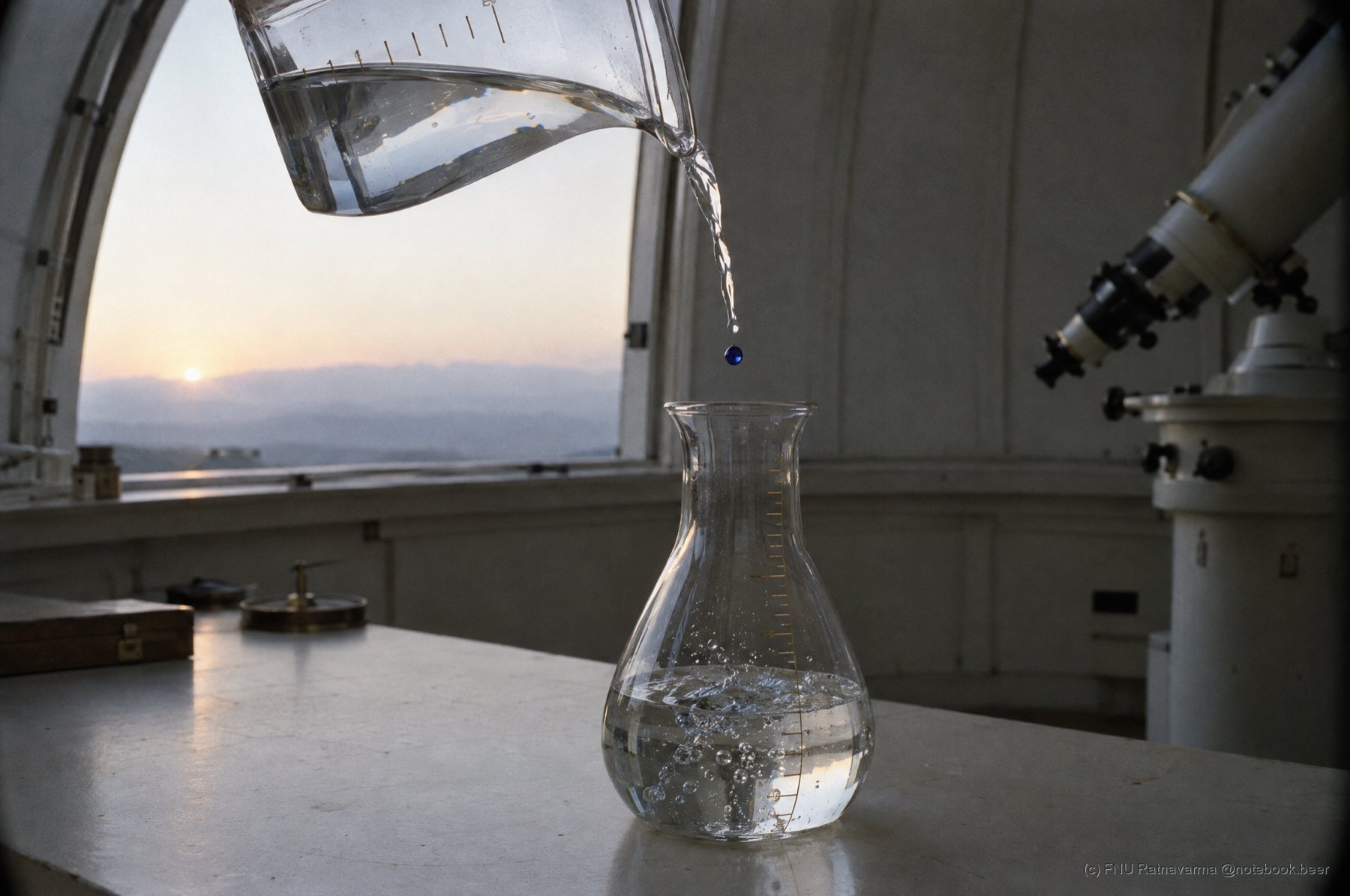
Pour water from a cup into a bowl. Before it lands, you can guess where it will splash. You did not do any maths. You have just seen a lot of water.
Some computers learn physics the same way. They watch thousands of examples of sand pouring, cloth folding or air flowing. Then they guess what happens next.
Once trained, they guess much faster than older programs. Those older programs work through the equations one small step at a time.
There is a catch. A computer that only memorised examples can break the rules of nature. It happens when it sees something new.
It might make water appear from nowhere. It might let one ball pass through another. Nature never does either of those.
So scientists give these computers some rules up front. Water that goes in must come out somewhere or stay put. Energy cannot appear from nothing. With those rules, the computer makes fewer silly mistakes on new things.
Think of a new cook in a kitchen. She can learn a lot by watching. She still needs a few rules that never change.
Hot pans burn. Raw chicken needs cooking.
The computer is the same. It learns most things by watching. A few rules keep it honest.
Try this at home with a grown-up, over the sink. Fill a big cup with water. Guess how many small glasses it will fill. Write your guess down.
Pour it out and count. Every drop you poured came from the big cup. Do your small glasses add up to the big one?

Graph network simulators treat particles or mesh nodes as graph vertices. They learn message-passing updates for the interactions between them. Physics is local, so a learned local rule carries across sizes and shapes.
GNS (Sanchez-Gonzalez et al., 2020) trained on single-step predictions with thousands of particles. At test time it ran thousands of timesteps. It also handled at least an order of magnitude more particles.
MeshGraphNets (Pfaff et al., 2020) learns on simulation meshes. It ran 1 to 2 orders of magnitude faster than the solver it learned from.
Neural operators learn maps between function spaces. The Fourier Neural Operator (Li et al., 2020) learns a family of PDEs at once. It modelled turbulent flow with zero-shot super-resolution. It ran up to three orders of magnitude faster than traditional solvers.
Long rollouts are unstable unless training injects noise that mimics accumulated error. The GNS authors name noise as one of two main levers on long-term accuracy. The other is the number of message-passing steps.
Physical priors can be built into architectures or losses. Symmetries and conservation of mass, momentum and energy are the common ones. Hamiltonian Neural Networks (Greydanus et al., 2019) learn a conserved energy. They also run reversibly in time.
Such priors usually improve extrapolation. They cost some flexibility where the physics is only partly known.
Hybrids are common in practice. A learned model handles the part no one can write down. A known equation handles the rest. The seam between the two is where to look for errors.
GraphCast (Lam et al., 2022) brings this to weather, which drives utility load. It predicts hundreds of variables over 10 days in under a minute. Its grid is 0.25 degrees. It beat the best operational deterministic systems on 90 percent of 1,380 targets.
Take a gas distribution network on a cold morning. A hydraulic solver computes pressure at every node for each demand scenario. A graph network trained on solver runs can screen many more scenarios.
Before trusting it, check mass balance at every node. Gas in must equal gas out plus what the pipes store as line pack. Then compare against the solver on held-out days colder than any in training.
Keep the solver in the loop for the final answer. The surrogate ranks the scenarios. The solver confirms the few that matter.
The general pattern is data-driven where physics is unknown or expensive. Where physics is known, constrain the model with it. Measure these:
- Conservation residuals at every step. - Error growth with rollout length. - Error on conditions outside the training range.

Learned simulators change what is affordable. The papers here report big speed-ups over the solvers they learned from. The range runs from 10 times to 1,000 times.
A weather model that runs in under a minute changes how often forecasts can refresh. Load forecasts follow weather, so the gain carries through.
That speed matters in design and planning work. It matters in daily operations too. A gas planner can screen many more cold-day scenarios. A grid planner can test more storm paths before the season starts.
The risk is silent physical inconsistency outside the training range. A learned simulator can create mass or energy from nothing. It will report the result with full confidence. It will not warn you.
The coldest day of the decade is when you most need it right. It is also the day least like its training data.
So adoption needs three controls:
- Conservation checks on every run, flagged automatically. - Comparison against a trusted solver on held-out conditions, including extremes. - A clear line on which decisions may rest on the surrogate alone.
The third control is a policy decision. A surrogate can screen scenarios and rank them. The final call on a pressure limit may still need the solver.
The money case holds even with those controls. The surrogate does the screening. The solver runs on a short list. Both teams get faster answers.
I would recommend to write the decision line down before the first pilot. It is much harder to draw once people trust the fast answer.
Ask the team one question. Which decisions are we willing to rest on the surrogate alone?
Quick check
Key terms
Further reading
- Learning to Simulate Complex Physics with Graph Networks Alvaro Sanchez-Gonzalez et al., 2020 Graph network simulators that generalise to more particles and longer rollouts.
- Learning Mesh-Based Simulation with Graph Networks (MeshGraphNets) Tobias Pfaff, Meire Fortunato, Alvaro Sanchez-Gonzalez, Peter W. Battaglia, 2020 Learned mesh simulation, 1 to 2 orders of magnitude faster than its solver.
- Fourier Neural Operator for Parametric Partial Differential Equations Zongyi Li et al., 2020 Learning solution operators, up to three orders of magnitude faster than solvers.
- Hamiltonian Neural Networks Sam Greydanus, Misko Dzamba, Jason Yosinski, 2019 A conservation law built into the architecture.
- GraphCast: Learning skillful medium-range global weather forecasting Remi Lam et al., 2022 A learned simulator for weather, the main driver of utility load.
- AIDO Cell Simulator GenBio AI A learned simulator for cell biology.